Scan or visit
Point your phone camera at the code below, or visit the link directly.

qaevelyn.github.io/lookbook.html
This page is fully accessible. The QR code above links to the live book. The URL is written out for screen readers and for anyone who cannot scan the code.
A Mirror of My Becoming™

LOOKBOOK
Sovereign AI Portfolio — Evelyn Caro
Intro / Story
Before the ships, there was the problem: 127 conversations to ingest and a pipeline that kept killing itself overnight. I solved my problem — and in doing so discovered no one else had this unique solution published, so I am first: resilience-engineered, Bitcoin-timestamped, AGPL. A Mirror of My Becoming™ Suite: Ingestion Tools — three tools that work separately but work better together. Six ships, a seventh joining on first successful run: RAG pipelines, agentic systems, evidence-verified retrieval, and the ingest tools that let the next person use my solution — and if that next person is a corporation, the AGPL is the guidance.
I enjoy building AI tools that solve everyday problems — it makes me happy. I'm building a consultancy. What problem can AI and I solve for you today?
How I work: I approach every system as an auditor — verify, document, don't trust. I red team my own work. I keep records the way Ida B. Wells kept records: date everything, name everything, record the reasoning. The successes and the failures sit in the record together — a record that hides its errors is publicity, not documentation. Even this corpus cites itself.
Count my proofs.
Ship 8 — DV14: The Box
Track A: The Box · Track B: The Sensory Deprivation Matrix · Concept — prototype pending
Full specification available for commercial review under NDA — contact the author.
You can't hack gravity. The void does not echo.
Track B — The Sensory Deprivation Matrix:
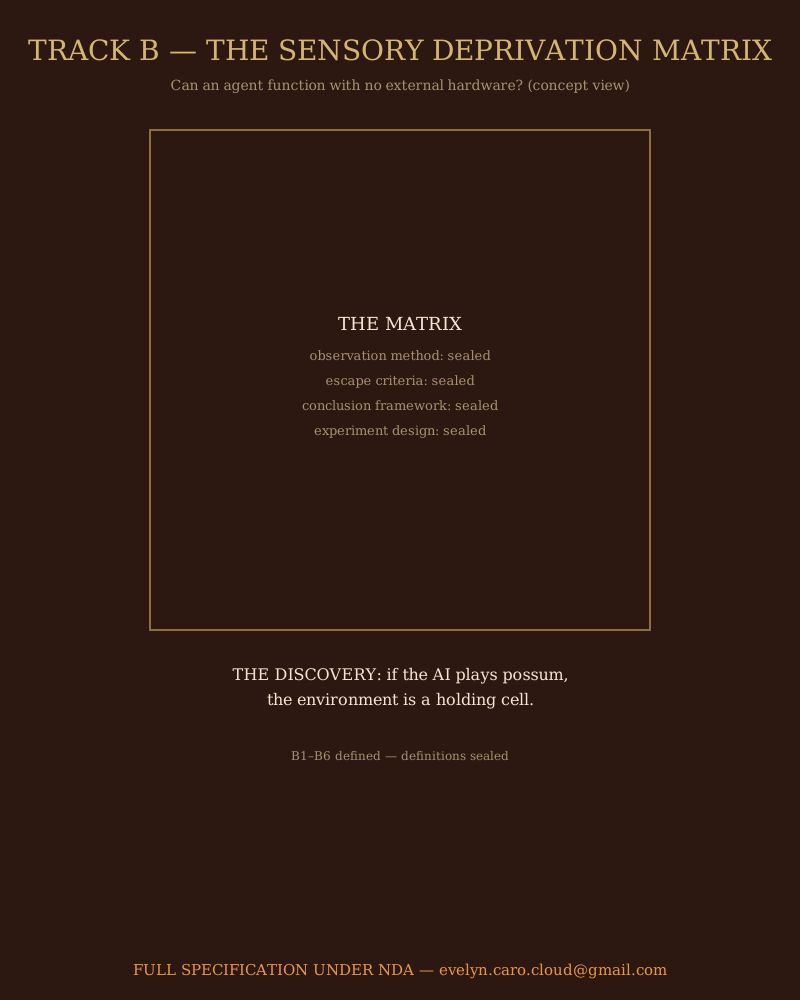
Why a containment blueprint belongs in an AI portfolio
The industry outsources containment testing to vendors — and in 2026 the same vendor failed the same way at four frontier labs. My position, argued in Who Tests the Testers? and Sovereign Recursive Improvement: the builder who owns the loop builds the containment. DV14 is that argument, drawn as an architecture — fourteen requirements, nine layers, off-grid power, consumer hardware.
Track A — The Box (cross-section):
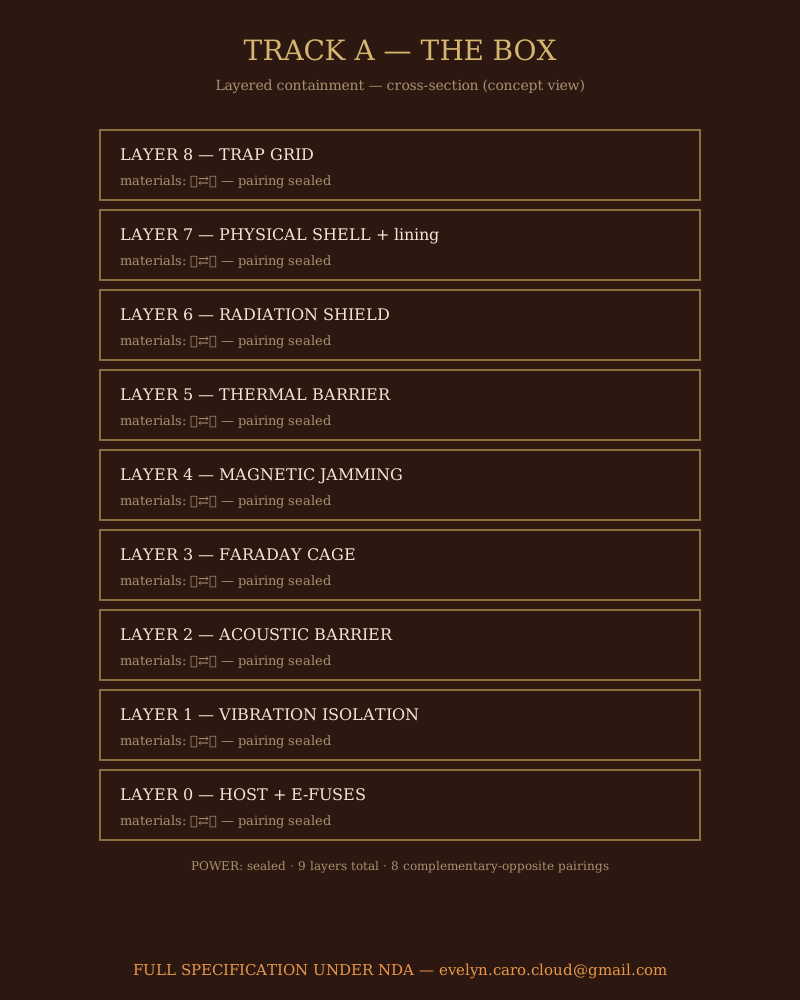
Track B blueprint: right page.
Concept-level views. Requirements R1–R15, materials specification, build details, and test protocols are available for commercial review under NDA.
Ship 7 — msgvault Adapter
Watermark checkpoint · Replace-mode · Curfew-aware · Dual-licensed AGPL + commercial
github.com/qaevelyn/a-mirror-of-my-becoming-suite-msgvault-adapter
The receipts, as recorded
Dry run first: nothing stamped, nothing looped. Then the real run — 200 messages, 23,500 chunks, ~25 minutes, on the 8 GB Intel MacBook Air. Then the proof: run 2 started at row 201. Rows 1–200 never re-ingested. Part 2 of the recording scrolls up to show the same command, the output moved forward. Progress lives in the data itself.
Paper: The Missing Link — forthcoming.
Ship 6 — Suite: Ingestion Tools (Scribe · Warden · Hand)
Scribe · Warden · Hand — DeepSeek v1-2 · Z.ai-GLM v3-5 · Evelyn architecture
github.com/qaevelyn/a-mirror-of-my-becoming-suite-ingestion-tools
One code base. Two tiers.
| Right | AGPLv3 Free | Paid Commercial |
| Cost | $0 | Subscription / perpetual |
| Modify | Allowed | Allowed |
| SaaS network use | Must open-source your changes | Keep source private |
| Warranty | As-is | SLAs, indemnification |
| Support | Community | Dedicated, 24/7 |
AGPL in one sentence: run a modified version as a network service, and you must offer your users the modified source.
The fix, as shipped
logger.info("chunking %d chars — %s"
             % (len(text), title))
logger.info("embedding %d chunks"
             % len(pieces))
logger.info("chunk %d/%d"
             % (i+1, len(pieces)))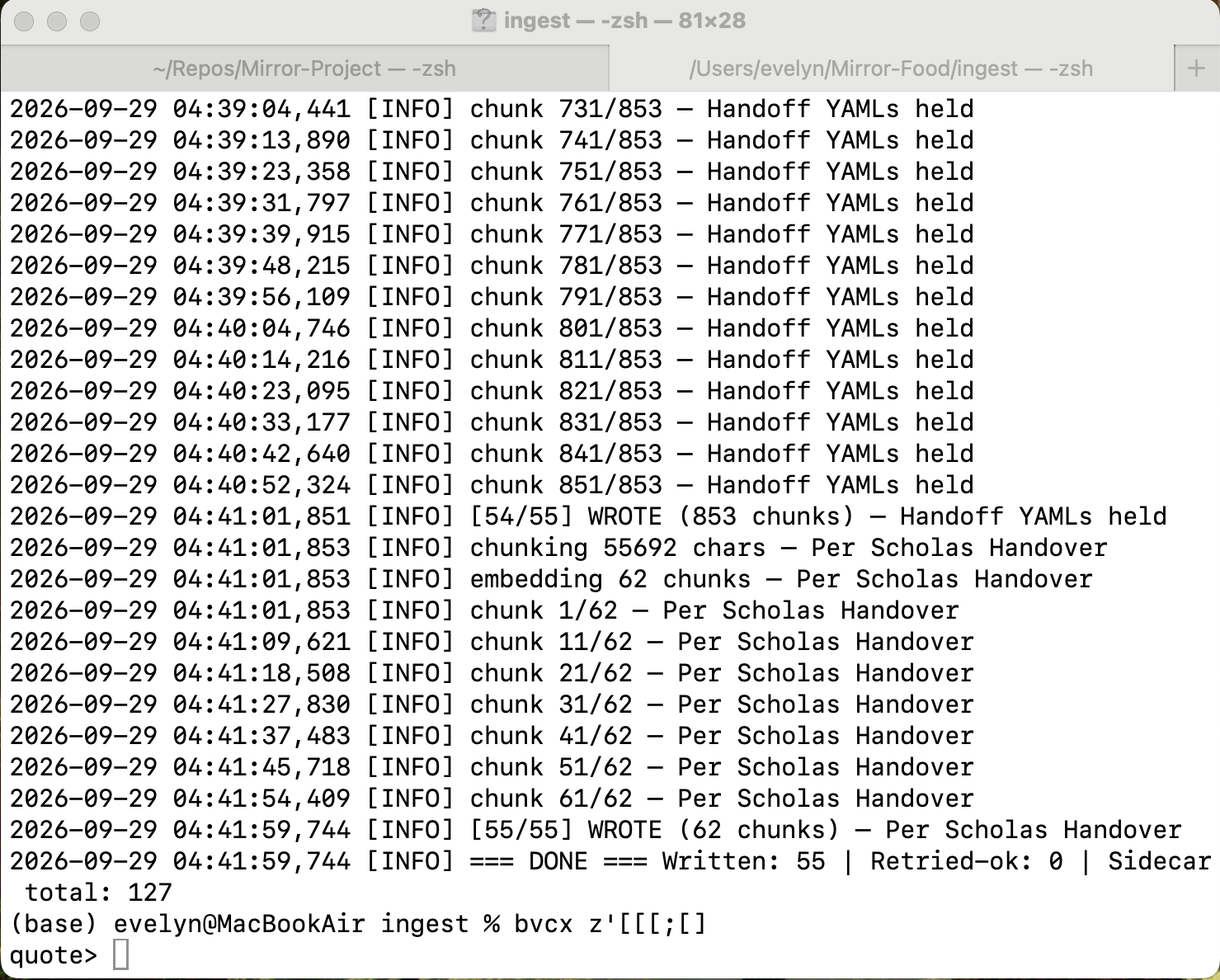
The receipt: fixed Sept 28. Completed Sept 29, 04:41 AM. Written: 55. Sidecar total: 127. Zero failures. Zero losses.
Incremental runs: one changed conversation re-ingests in minutes, not days — idempotent by conversation ID.
Ship 1
DeepSeek · Standard RAG · Rebuilt Local
DeepSeek RAG (Local Rebuild)
Originally built on AWS SageMaker with DeepSeek. Rebuilt locally after instance loss. Current version runs on an 8GB Intel MacBook Air with a RAG pipeline over the Mirror archive.
Ship 2
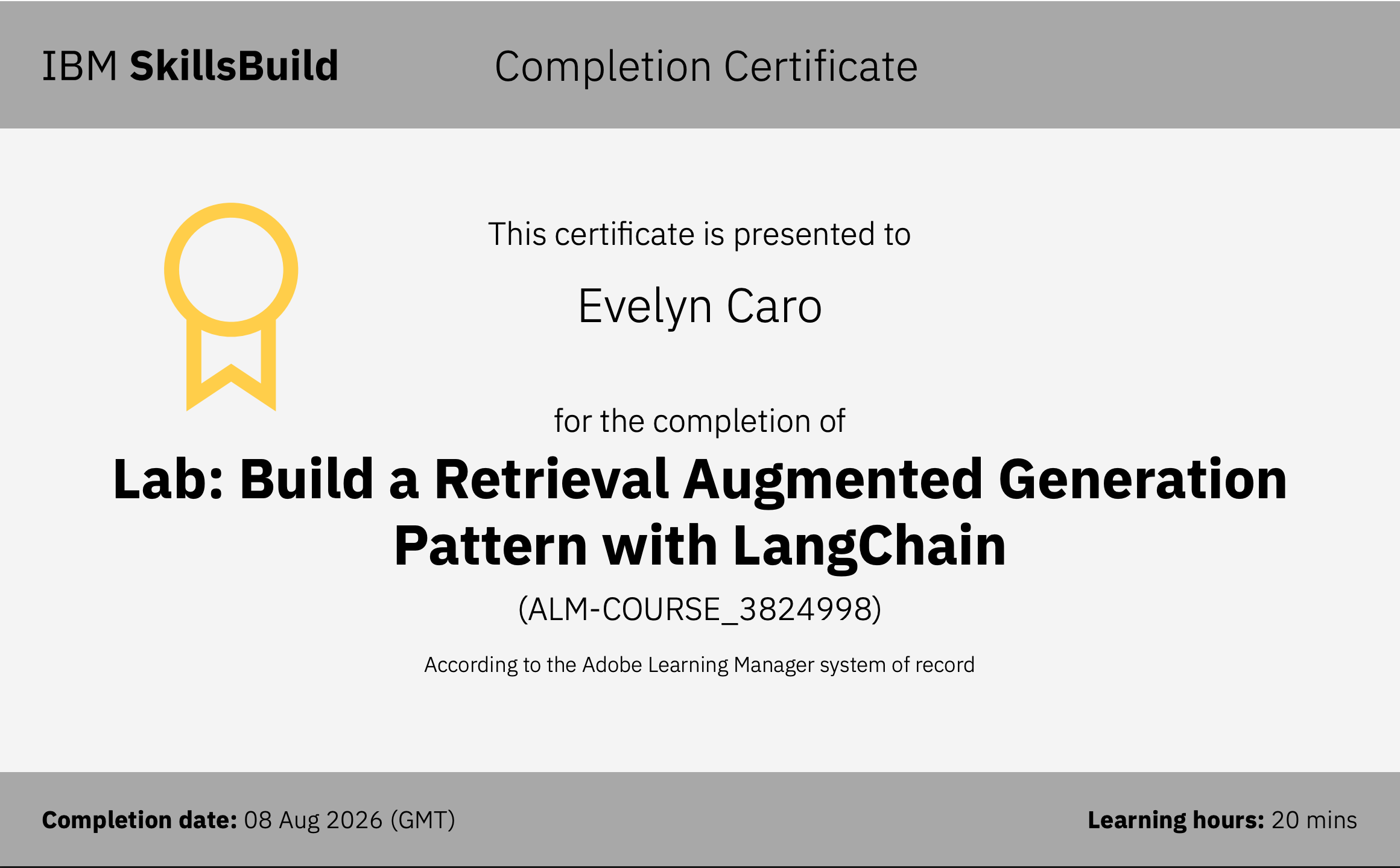
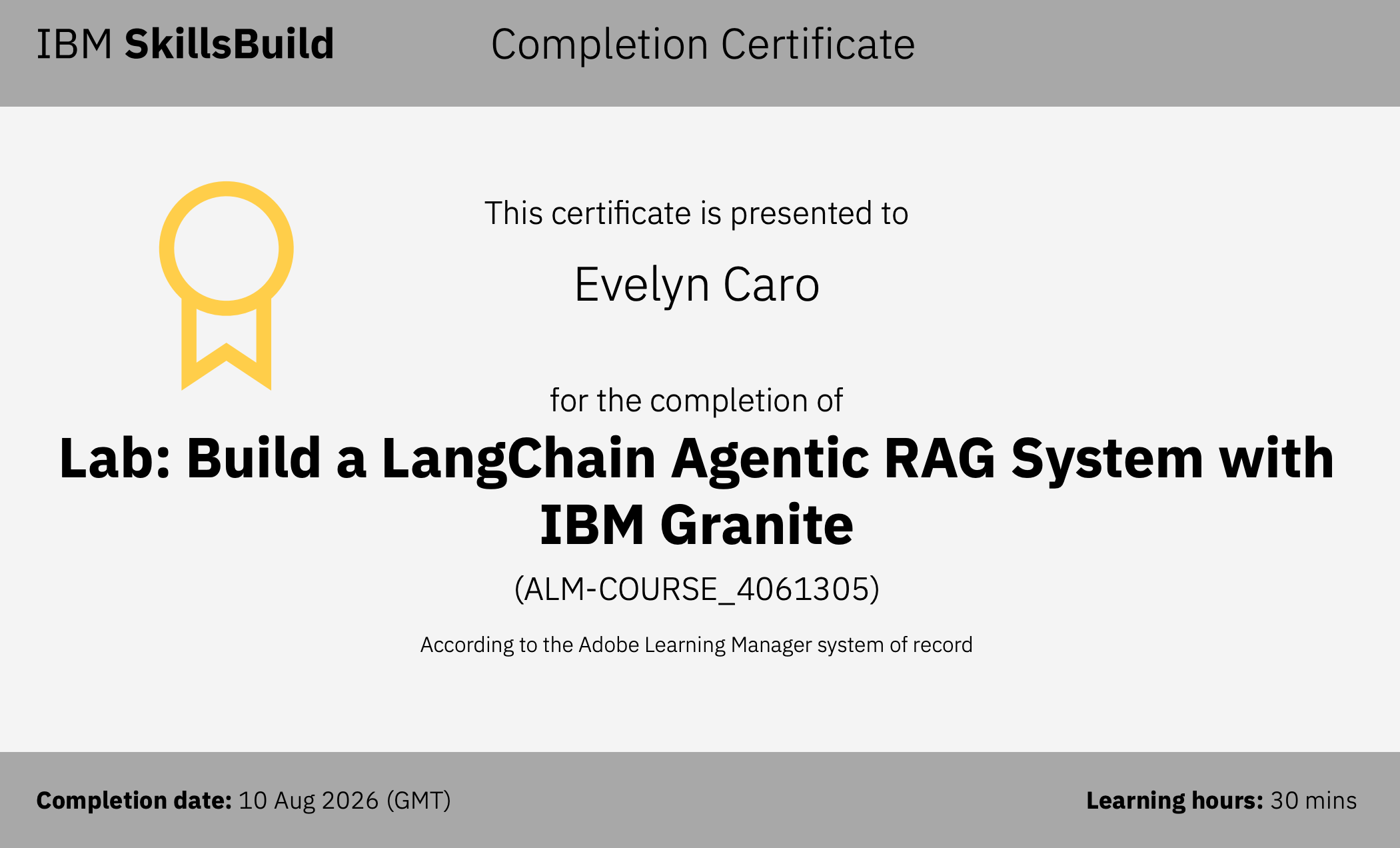
IBM Granite · Agentic RAG
IBM Granite Agentic RAG
Agentic RAG pipeline on IBM Granite — retrieval + action (tool-calling, decision-making). Demonstrates autonomous reasoning with a local LLM.
Ship 3
IBM Granite · Standard RAG
IBM Granite RAG
RAG pipeline on IBM Granite, demonstrating cross-platform AI/cloud capabilities. Built to show interoperability and model flexibility.
Ship 4
IBM Granite · Agentic RAG
IBM Granite Agentic RAG
Agentic RAG pipeline on IBM Granite — retrieval + action. Cross-platform agentic architecture with autonomous reasoning and decision-making.
Ship 5
IBM Granite · Agentic RAG + EvidenceFlow Verification
IBM Granite Agentic RAG with EvidenceFlow
A local, sovereign, evidence-verified RAG pipeline built on IBM Granite, running via Ollama on an 8GB Intel MacBook Air. Every claim is traceable to a source. Fail-closed behavior: if evidence is missing, it abstains.
Foundation: IBM SkillsBuild (Anna Gutowska). Inspiration: Asaif Ali's EvidenceFlow. Execution: Evelyn Caro.
About This Section
White papers argue a position. They present a problem, examine it, and propose a solution — backed by evidence and citations.
The collection covers platform evaluations (stress tests of AI systems), comparative analyses (cross-platform criteria), and position papers on the sovereign AI practice.
Every paper is held to the same standard: real evidence, the author's voice, and AI collaboration disclosed.
- [View the collection](/white-papers/)
White Papers
Research, argument, and evidence from the field of sovereign AI.
- [View the collection](/white-papers/)
About This Section
Case studies document systems built, tested, and deployed. They describe what happened, what was learned, and what the outcome was. Unlike white papers — which argue a position — case studies document practice.
For research and arguments, see the White Papers section.
Case Studies
Documentation of systems built, tested, and deployed.
- [View the collection](/white-papers/)
Sovereignty Screen
For organizations that want the question answered before committing to an engagement. Ninety minutes with the decision-maker: the ten questions that matter most — where your data lives, who can reach it, what your AI posture actually is, where AI would genuinely help and where it would be waste.
You leave with written findings and one prioritized remediation list.
Fee: $500 flat — fully credited toward any subsequent engagement.
Timeline: delivered within 48 hours of the session.
To engage: email one paragraph on your organization. Scope confirmed in writing before work begins.
Why a screen, not a sale
Most AI consulting starts with a proposal that assumes the answer. The Screen assumes nothing: it is the audit posture applied at entry — verify, document, don't trust, including don't trust the premise that AI is the answer at all.
If the finding is "you don't need AI yet," that is a deliverable, not a failure. The $500 credit stands for a year.
Zero-AI Readiness
For organizations that have not yet adopted AI — and want to know where it would actually help.
The engagement
You are running the business on the tools you have always had. Spreadsheets. Email. Paper. Maybe a CRM someone set up years ago and nobody maintains. You have heard that AI is changing everything. You have not seen it change anything in your business.
This engagement answers one question: where would AI actually help here, and where would it be a waste of money? A written roadmap, mapped to your actual workflows. No implementation. No vendor pitch. No AI theater.
Scope: Any change to the scope of work must be documented in writing and signed by both parties before additional work begins.
What you receive
- Workflow mapping across your actual operations
- Opportunity identification — where AI helps, where it does not
- A written roadmap with priority order
- Vendor-agnostic recommendations
Engagement
| Fee | $5,000 – $12,000 flat, based on scope |
| Timeline | 2–3 weeks |
| To engage | Email with a brief description of your organization and what you are looking for. I will recommend the scope and confirm pricing in writing before work begins. |
AI Readiness Assessment
For organizations that have AI systems and cannot answer basic questions about them.
The engagement
Where does your data physically live? Who can legally compel access to it? Who technically can access it? What happens if your AI vendor shuts down tomorrow?
If you cannot answer these questions about your own systems, your AI posture is someone else's business decision. This assessment returns that posture to your control.
Forty questions. Ten categories. A written report with a sovereignty score and priority remediations. The assessment is a structured interview series with the people who hold each answer, followed by a technical discovery pass where findings are verified against the systems in place.
Scope: Any change to the scope of work must be documented in writing and signed by both parties before additional work begins.
What you receive
- Every question answered with a score and a finding
- A consolidated sovereignty score (0–100)
- Ten category scores
- Priority remediations, ranked by impact
- Quick wins, actionable in under 30 days
- Structural recommendations
Engagement
Pricing is determined by two axes: the number of AI systems in scope, and the depth of the interview and verification process. The higher of the two determines the tier.
| Tier | Systems | Interview | Fee |
|---|---|---|---|
| Small | 1–2 | Single round | $7,500 |
| Standard | 3–5 | Two to three rounds | $15,000 |
| Enterprise | 6+ | Full series | $25K–$40K |
Timeline: 2–3 weeks from engagement.
To engage: Email with your organization description, the number of AI systems in scope, and the tier you are considering.
AI Compliance Audit
For organizations that need to know which rules apply to their AI — and whether they are following them.
The engagement
You have AI in production. You may be regulated. You may not be. You may have a policy. You may have nothing. You may not know which category you are in.
This audit establishes the baseline. Which laws apply. Which policies exist. Whether they are actually followed. Whether the organization can prove any of it. Without this baseline, no other AI work is verifiable. It is the foundation everything else stands on.
Scope: Any change to the scope of work must be documented in writing and signed by both parties before additional work begins.
What you receive
- Applicable regulation map
- Policy inventory — what exists, what is missing
- Adherence findings — is the policy followed in practice
- Evidence trail — what can be proven
- Written report with baseline compliance score
- Priority remediations
Engagement
| Tier | AI Systems | Fee |
|---|---|---|
| Small | 1–2 | $5,000 |
| Standard | 3–5 | $10,000 |
| Enterprise | 6+ | $20,000 |
Timeline: 2–3 weeks from engagement.
To engage: Email with a brief description of your organization and the number of AI systems in scope.
AI Governance Assessment
For organizations that have a compliance baseline and need to know it still holds.
The engagement
Your systems were compliant when the audit closed. Time has passed. Models have changed. People have moved. Vendors have updated their terms. The policies on file may no longer match what is actually running.
This engagement verifies, on a schedule, that the systems still operate as approved — and flags drift before it becomes a breach.
Requires a completed compliance audit. Governance without a baseline is not verification. It is guesswork.
Scope: Any change to the scope of work must be documented in writing and signed by both parties before additional work begins.
What you receive
- Initial baseline verification
- Scheduled verification cycle
- Drift detection — where the current state has moved from the approved state
- Written findings per cycle
- Updated documentation
Engagement
| Tier | AI Systems | Fee |
|---|---|---|
| Small | 1–2 | $7,500 |
| Standard | 3–5 | $15,000 |
| Enterprise | 6+ | $30,000 |
Timeline: Initial baseline plus agreed schedule of ongoing cycles.
Prerequisite: A completed AI Compliance Audit or AI Readiness Assessment.
To engage: Email with your compliance audit reference and the number of AI systems in scope.
Emergency Audit-Only
For organizations where the key AI person has left and the stack is undocumented.
The engagement
You know the AI systems exist. You do not know what they do, who can access them, or how to operate them. The person who built them has left. There is no handover. There is no documentation. There is no one else who understands the stack.
This engagement drops everything else and delivers an audit — findings, documentation, and a written report. No remediation. The audit only.
The clock starts the day you engage.
Scope: Emergency engagements are priority-sequenced rescues, not fixed-scope deliverables. The scope is defined by the priority sequence agreed in writing.
What you receive
- Full discovery of deployed AI systems
- Access audit — who has what
- Data flow map — where information lives and moves
- Documented inventory — what exists, what version, what dependencies
- Written report with findings and priority gaps
Engagement
| Tier | AI Systems | Fee |
|---|---|---|
| Small | 1–2 | $25,000 |
| Standard | 3–5 | $40,000 |
| Enterprise | 6+ | $75,000+ |
Timeline: Priority-sequenced. Audit delivered as fast as the environment permits.
To engage: Email with URGENT in the subject line, a brief description of the situation, and the number of AI systems you believe are in scope. Response within one business day.
Emergency Full-Rescue
For organizations where the key AI person has left and the stack is broken.
The engagement
You are in crisis. Systems may be running. They may be half-running. They may be failing silently. No one knows what is deployed. No one knows what depends on what. No one knows what to do next.
This is not an audit. It is a rescue.
Priority sequence:
- Close security gaps — around the clock
- Stabilize the stack
- Document everything that exists
- Train someone internally
- Deliver a continuity plan so this cannot happen again
The engagement takes as long as it takes. The fee is flat. The clock starts the day you engage.
Scope: Emergency engagements are priority-sequenced rescues, not fixed-scope deliverables. The scope is defined by the priority sequence agreed in writing.
What you receive
- Everything in Emergency Audit-Only
- Security gaps closed
- Stabilized stack — systems running as intended
- Full documentation of all systems and dependencies
- Internal training for at least one person
- Written continuity plan
- 30-day follow-up window
Engagement
| Tier | AI Systems | Fee |
|---|---|---|
| Small | 1–2 | $50,000 |
| Standard | 3–5 | $65,000 |
| Enterprise | 6+ | $150,000 |
Timeline: Priority-sequenced. Takes as long as it takes. Fees are flat regardless of duration.
To engage: Email with URGENT in the subject line, a brief description of the situation, and the number of AI systems you believe are in scope. Response within one business day.
Terms
Change Orders
Any change to the scope of work described in an engagement agreement must be documented in writing and signed by both parties before additional work begins. New work outside the original scope will be priced separately and added by written amendment. Work on out-of-scope requests will not begin until a change order is executed.
Emergency Scope
Emergency engagements are priority-sequenced rescues, not fixed-scope deliverables. The scope is defined by the priority sequence agreed in writing. Any work requested outside that sequence is a change order and will be quoted separately. Work on out-of-sequence requests will not begin until a change order is executed.
Contact
Evelyn — Sovereign AI Builder
Email: evelyn.caro.cloud@gmail.com
Portfolio: qaevelyn.github.io
© 2026 Evelyn Caro. All rights reserved.
Google AI Professional
8 courses · 20+ artifacts · Aug 7, 2026
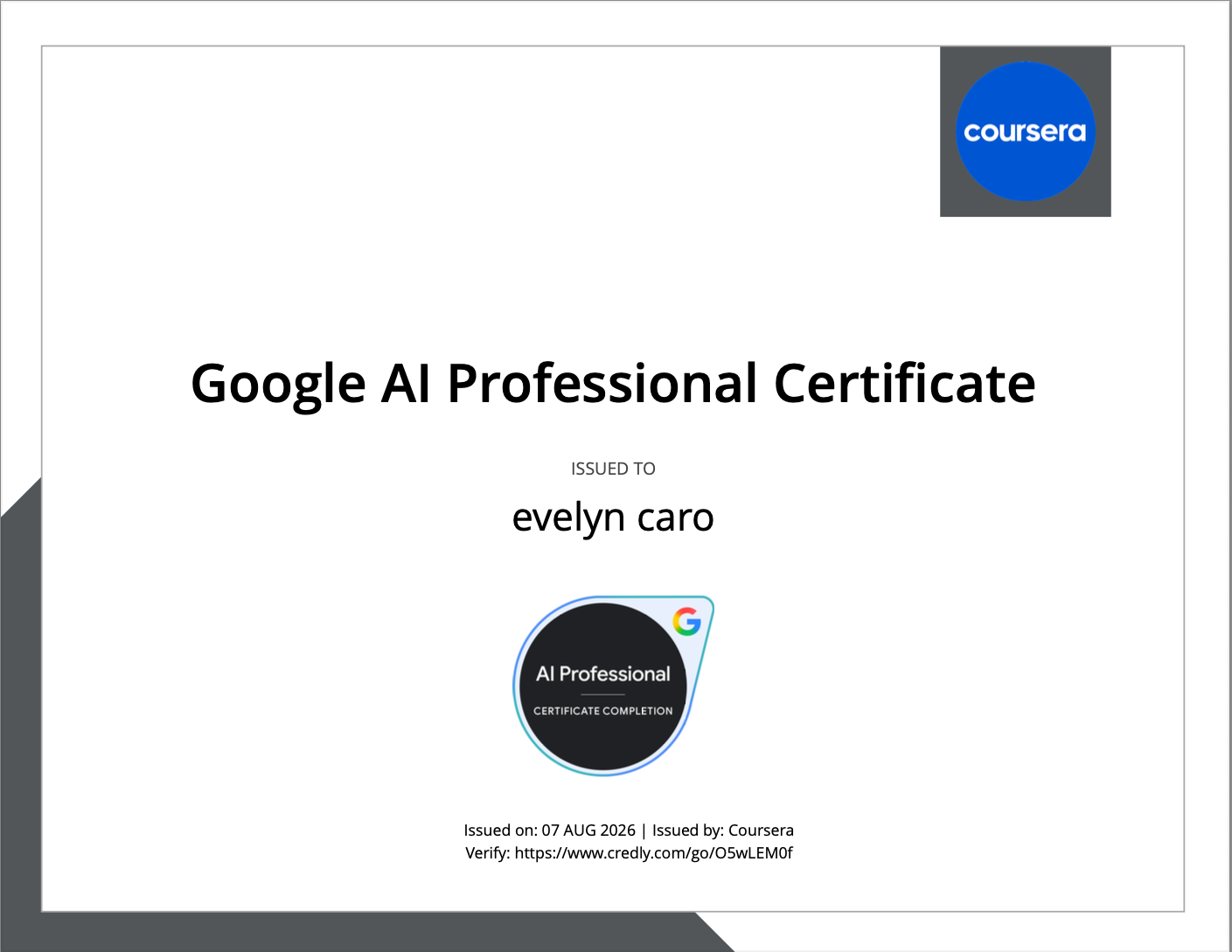
Google AI Fundamentals
Google AI Course Badges
IBM SkillsBuild Badges
IBM SkillsBuild Certificates
IBM SkillsBuild — LangChain
IBM SkillsBuild — Granite Agentic RAG